
Existing fire pump troubleshooting and corrective repair
Fire Pump Repair in Miami
Florida Fire Solutions provides fire pump repair in Miami for leaks, poor pressure and operating faults by reviewing the reported symptom, existing records and installed equipment before defining the corrective work.
Start with the symptom, not an assumption
Diagnose the fire pump problem before deciding what needs to be repaired
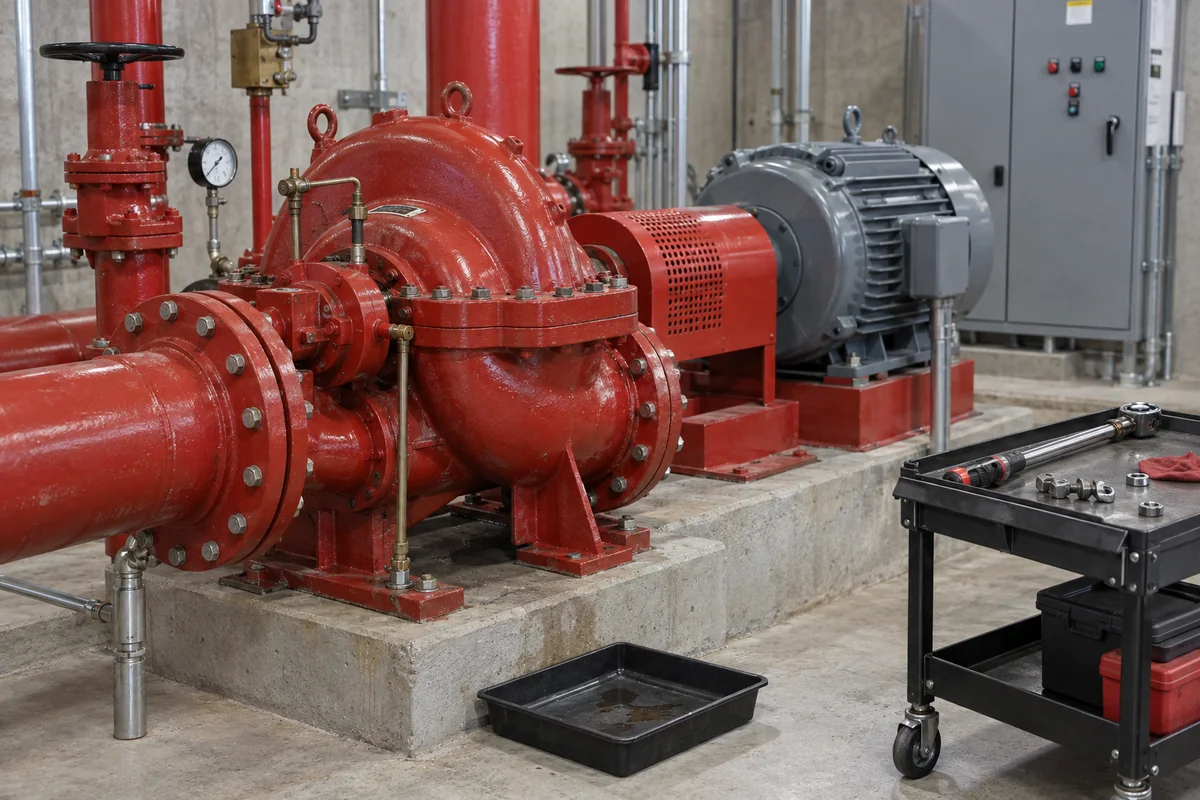
Florida Fire Solutions provides Fire Pump Repair in Miami for existing equipment with leaks, poor pressure, abnormal operation or other reported faults that need a focused site assessment and corrective scope.
When a diesel fire pump has overheating, coolant leakage, restricted cooling flow or a failed cooling component, Diesel Fire Pump Cooling Repair in West Palm Beach focuses on the installed engine coolant, radiator, heat-exchanger or cooling-water arrangement before defining the corrective repair and operational verification.
When a diesel fire pump has a cranking or no-start failure, Diesel Fire Pump Starting Repair in Miami isolates batteries, chargers, heavy cables and connections, start circuits and engine-side causes before the corrective repair and readiness verification are defined.
A pressure problem does not automatically mean the fire pump itself has failed. Low or unstable pressure can be connected to the pump, suction conditions, the driver, controls, piping or another part of the fire protection water supply. The first step is to review the reported condition and identify which equipment or interface is actually involved.
Send any previous inspection or test report, describe what building staff observed, and provide the pump, motor and controller information that is available. That helps the technician start with the known condition instead of guessing from a symptom alone.
Call now to describe the fire pump problem and schedule a service visit. For broader existing-pump inspection, testing and maintenance needs, see our Fire Pump Services in Miami.
Reported symptoms and prior findings
Use the equipment history to narrow the problem before corrective work begins
The same symptom can have more than one possible cause. A useful repair assessment combines what the building observed with the available pump records and the condition found during the site visit.
Leaks or visible water
Identify where the water appears, when it occurs and whether the condition changes while the equipment is operating. The source needs to be confirmed before the repair is defined because leakage can involve different pump or piping components.
Poor or unstable pressure
Provide previous pressure or flow-test records when available and describe what changed. The assessment should consider the complete pump operating condition rather than assuming that low pressure automatically requires pump replacement or rebuilding.
Operating or starting faults
Report alarms, unusual sounds, vibration, failure to start or other operating concerns exactly as they were observed. Controller history or previous service notes can help determine whether the problem is mechanical, control-related or connected to another part of the installation.
NFPA 25 includes fire pumps within its inspection, testing and maintenance scope, and its informational troubleshooting annex identifies multiple possible causes for symptoms such as low discharge pressure. That is why a repair decision should follow assessment of the actual condition rather than a symptom-only diagnosis.
Corrective repair scope
Define the repair around the component and condition that were actually confirmed
Once the problem is narrowed down, the corrective scope should identify the affected equipment, the repair being proposed and any separate work that falls outside the original service request.
- Pump identification: confirm the specific fire pump included in the repair request, especially where a property has more than one pump.
- Motor and coupling area: document the condition when the reported fault involves noise, vibration, alignment concerns or operation at the pump and driver connection.
- Piping and gauges: identify whether the problem involves connected fire protection piping, valves, gauges or other items rather than the pump assembly itself.
- Controller-related findings: if the assessment points to the controller, treat controller repair or replacement as its own component scope rather than assuming it is part of mechanical pump repair.
- Pressure-maintenance equipment: if a jockey pump or related component is the actual source of the issue, separate that work from the main fire pump repair.
- Major internal or packing work: complete rebuilding or packing-only work should be separately defined when assessment confirms that specialized repair is needed.
The repair quote should follow the confirmed condition. A visit that begins as a leak or pressure complaint can lead to a smaller component repair, a separate controller or jockey-pump scope, specialized packing work, or a larger rebuilding project depending on what is actually found.
If the reported problem is part of a broader fire sprinkler deficiency instead of a pump-specific issue, Florida Fire Solutions also provides fire sprinkler repair in Miami.
Call now if you have a report, equipment information or current symptom ready and want to schedule the assessment that will define the repair scope.
Post-repair verification
Confirm the corrected condition before closing the repair
Repair work should end with verification appropriate to the component and problem that were corrected. The goal is to document what changed and confirm that the reported fault has been addressed without overstating what one repair proves about the entire fire protection system.
Review the repaired component
Confirm the corrected item is assembled, secured and returned to its intended service condition before the repair is treated as complete.
Verify the reported symptom
Where the repair addressed leakage, pressure behavior or an operating fault, the closeout should include an appropriate operational check or test tied to that condition and the equipment that was repaired.
Record the work performed
Keep the repair description, replaced components when applicable, test or verification results and any remaining recommendations with the property’s fire pump records for future service.
NFPA 25 materials distinguish maintenance and repair activity from fire pump testing and include recordkeeping for pump maintenance or repair. The appropriate verification depends on the component corrected and the reason for the repair; this page does not assume that every repair requires the same test procedure.
If the remaining question is specifically whether an existing pump can deliver required performance under flowing conditions, see Fire Pump Flow Testing in Miami for that separate testing need.
Common questions
Questions before scheduling fire pump repair
What should I send before a Miami fire pump repair visit?
Send the property address, building contact, pump-room access information, available pump and controller details, recent inspection or test records, and a clear description of the leak, pressure problem or operating fault. Photos can also help show the reported condition before the visit.
Does low pressure mean the fire pump has failed?
Not necessarily. Low discharge pressure can have several possible causes involving the pump, suction conditions, the driver, controls or related components. The condition should be assessed before deciding which repair is appropriate.
Can a previous fire pump test report help diagnose the repair?
Yes. Previous test results can show what the pump was doing before the current problem appeared and can help identify changes that need closer evaluation. Send the most recent report when it is available.
Is controller replacement included in fire pump repair?
Not automatically. If the assessment shows that the controller is the actual source of the problem, controller repair or replacement should be defined as its own component scope.
What if the problem is the jockey pump or packing?
If the assessment identifies the pressure-maintenance pump, packing or another specialized component as the actual issue, that work should be scoped separately around the confirmed condition rather than assumed to be part of a general fire pump repair visit.
How is the repair checked after the work is completed?
The verification should match the component repaired and the symptom that created the service request. That can include an operational check or other appropriate test, followed by documentation of the repair and any remaining recommendations.
Schedule fire pump repair in Miami
Send the reported symptom, available pump and controller information, recent records and pump-room access details. Florida Fire Solutions can assess the condition, define the corrective scope and verify the repair result.
Or call directly (305) 707-3473